

How to Choose the Right Architect for Your Dream Project
- Exotistic Design Studio
- Jul 28
- 9 min read

A great architect can save you from expensive mistakes long before construction begins. The wrong one can turn a promising project into months of confusion, cost overruns, design compromises, and approval delays.
Whether you are building a luxury villa, a compact city home, a retail outlet, a restaurant, a resort, or a commercial space, the architect shapes more than the look of the project. They help define the layout, budget, materials, approvals, comfort, long-term maintenance, and the way people will use the space every day.
Choosing the right architect is not about picking the most stylish portfolio. It is about finding a professional who understands your goals, respects your budget, communicates clearly, and can turn ideas into a buildable plan.


Start by defining what you really need
Before you shortlist architects, get clear about the project itself. A vague brief often leads to vague proposals. You do not need every answer at the start, but you should know the basics.
Write down the purpose of the project. A weekend villa needs a different design approach from a family home used every day. A restaurant needs customer flow, kitchen planning, washrooms, acoustics, ventilation, and brand experience. A retail outlet needs display, lighting, storage, signage zones, and easy movement. A resort needs comfort, privacy, operations, and landscape planning.
Also decide what matters most. For some projects, the top priority is staying within budget. For others, it is natural light, privacy, low maintenance, premium finishes, energy efficiency, or a striking design.
A useful starting brief includes:
Type of project
Approximate plot size or built-up area
Location and site conditions
Expected budget range in ₹
Number of rooms or key functions
Preferred style and must-have features
Timeline expectations
Any vastu, accessibility, parking, or future expansion needs
This brief helps the architect respond with better ideas. It also helps you compare proposals fairly.
Check qualifications, registration, and relevant experience
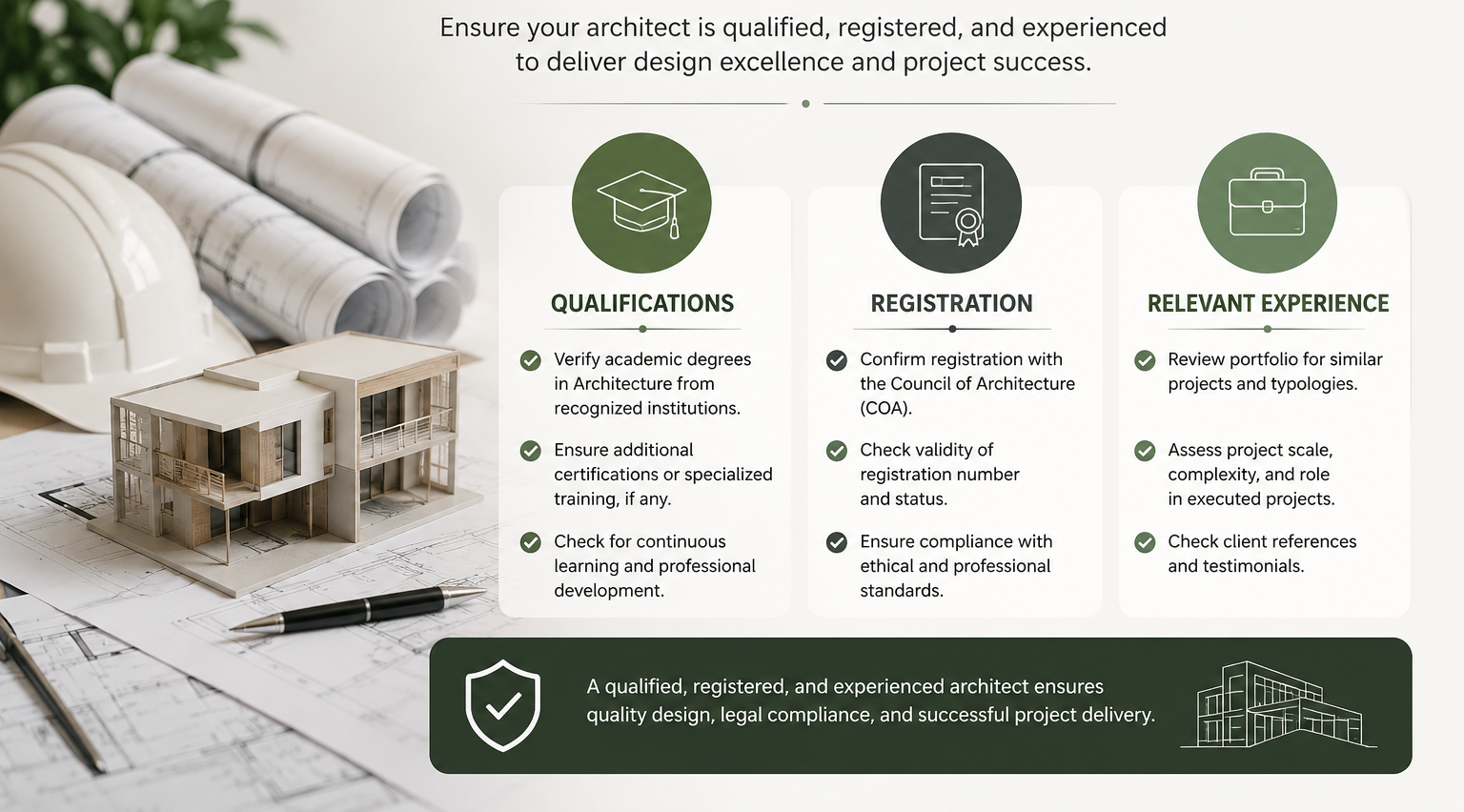
In India, a professional who uses the title “Architect” should be registered with the Council of Architecture. Ask for the architect’s registration details. This is a basic check, not a formality.
Next, look at experience that matches your project type. An architect who designs beautiful apartments may not be the best fit for a boutique resort. A commercial architect may understand traffic flow and services better than someone who mostly works on small residences.
That does not mean you should reject a younger or smaller studio. Many smaller practices are highly thoughtful and hands-on. The key is to check whether they understand the scale, approvals, technical needs, and coordination required for your project.
Use this simple comparison:
What to check | Why it matters |
Council of Architecture registration | Confirms professional standing in India |
Similar project experience | Reduces learning gaps and design risks |
Local approval knowledge | Helps with smoother permissions and compliance |
Construction coordination experience | Improves execution on site |
Familiarity with your budget range | Keeps proposals realistic from the start |
For commercial projects, ask if they have worked with consultants for structure, MEP, fire safety, kitchens, acoustics, landscape, or lighting. For homes, ask about practical details such as storage, ventilation, waterproofing, ageing-friendly layouts, and maintenance.
Study the portfolio beyond good-looking images
A portfolio can impress quickly, but look deeper than polished photos. Ask what problem each project solved. Good architecture is not only about visual style. It is about fit.
When viewing past work, notice:
Whether the spaces look usable, not just photogenic
How the architect handles light and ventilation
Whether layouts feel logical
How materials suit local climate and maintenance
Whether the design feels timeless or trend-driven
How well indoor and outdoor spaces connect
Whether finished projects match the drawings
Ask to see a mix of concept drawings, working drawings, and completed photos. Concept renders show imagination. Working drawings show technical discipline. Completed photos show whether designs can survive the reality of construction.
For a home, look for kitchens that work, bathrooms with practical service access, bedrooms with privacy, and pleasant transitions between spaces. For a restaurant or retail outlet, look for circulation, lighting, entry experience, customer comfort, and back-end planning.
A strong portfolio should tell you, “This architect can solve problems like mine.”

Understand the architect’s design process

A good architect follows a clear process. This protects both design quality and budget control.
Most projects move through stages such as:
Initial consultation
The architect understands your needs, site, budget, and goals.
Site study
They review orientation, access, climate, levels, views, neighbours, and local restrictions.
Concept design
They create layout options, mood direction, and broad design ideas.
Design development
The chosen concept becomes more detailed, with materials, sections, elevations, and room planning.
Approvals and permissions
Drawings are prepared for local authority requirements, where applicable.
Working drawings
Detailed drawings guide civil work, electrical, plumbing, flooring, doors, windows, and finishes.
Coordination during construction
The architect answers site queries, reviews progress, and helps maintain design intent.
Ask each architect how they manage these stages. Also ask what is included in their fee and what costs extra. Some architects provide design only. Others offer site visits, consultant coordination, interior design, landscape inputs, or turnkey support.
Clarity at this stage prevents disputes later.
Talk openly about budget from the beginning
Budget discomfort causes many project problems. Some clients hide the real budget, hoping for a better deal. Some architects design without enough cost checks. Both approaches create trouble.
Share a realistic budget range early. Include not only building cost, but also professional fees, approvals, consultant fees, interiors, loose furniture, landscaping, taxes, services, and contingency.
For example, a villa budget should not cover only civil construction. It may also need air-conditioning, kitchen equipment, wardrobes, lighting, security systems, compound wall, driveway, garden, water storage, and backup power.
Ask the architect how they design to a budget. Good answers may include:
They discuss cost priorities before concept design
They suggest material options at different price points
They coordinate with quantity surveyors or contractors when needed
They warn you when an idea may raise costs sharply
They help phase work if needed
Be cautious if someone promises a premium result at an unrealistically low cost. Also be cautious if an architect dismisses budget concerns as a later issue. Design decisions made in the first few weeks can affect lakhs of rupees during construction.
Evaluate communication style and working chemistry

A project can run for months or years. You need an architect you can speak with honestly.
During the first meeting, notice how they listen. Do they ask good questions? Do they explain trade-offs clearly? Do they respect your practical needs? Do they challenge weak ideas without sounding dismissive?
Good communication does not mean the architect agrees with everything. It means they guide you with reasons.
For example, if you ask for a double-height living room, a good architect may explain the impact on cooling, privacy, structure, cost, and usable floor area. They may still include it, but they will help you understand the choice.
Set expectations for communication early:
Who will be your main point of contact?
How often will updates happen?
Will meetings be online, on site, or in person?
How are decisions recorded?
How many design revisions are included?
What is the expected response time for urgent site questions?
The best working relationships feel structured, respectful, and honest.
The right architect does not simply draw what you ask for. They help you discover what the project truly needs.
Ask about approvals, local rules, and consultants
Every project must respond to rules. These may include building setbacks, height limits, floor area ratio, parking norms, fire safety, accessibility, environmental conditions, and local development control regulations.
For homes, this may involve municipal approvals, panchayat rules, gated community guidelines, or layout restrictions. For commercial projects, requirements can be more detailed, especially for restaurants, resorts, clinics, schools, or large retail spaces.
Ask the architect:
Which approvals may apply to this project?
Who prepares approval drawings?
Who submits and follows up with authorities?
What consultants may be required?
How will structural, plumbing, electrical, HVAC, and fire safety inputs be coordinated?
What documents will be handed over at each stage?
Architects do not work alone on larger projects. A well-run team may include structural engineers, MEP consultants, landscape designers, lighting consultants, kitchen consultants, and project managers. The architect often acts as the design lead who keeps these inputs aligned.
Learn how to choose the right architect for your home or commercial project with expert tips on portfolios, budgets, communication, and project success. The practical goal is simple: reduce surprises before money is spent on site.

Review fees with care, not just price
Architectural fees can be structured in different ways. Some charge a percentage of project cost. Some charge per sq ft. Some quote a lump sum. Some separate architecture, interiors, site visits, and consultant coordination.
Do not choose only the lowest fee. A cheaper architect can become expensive if drawings are incomplete, site coordination is weak, or the design causes waste. At the same time, a high fee does not guarantee better service.
Compare proposals by scope.
Look for details such as:
Number of concept options
Number of revisions
Drawing deliverables
3D views or models
Approval drawings
Working drawings
Interior design scope
Site visit frequency
Consultant coordination
Tender or contractor support
Payment schedule
Ownership and use of drawings
Ask what happens if the project pauses, expands, or changes direction. Also ask whether travel costs, printing, government fees, consultant fees, and site supervision are included or billed separately.
A good fee proposal should feel clear enough that both sides know what is promised.
Speak to past clients and visit completed projects
References reveal what portfolios cannot. Ask for past client contacts, preferably from projects similar to yours. If possible, visit one completed project and one ongoing site.
When speaking to past clients, ask direct but fair questions:
Was the architect easy to reach during construction?
Did the project stay close to the agreed design?
Were budget warnings given early?
Were drawings detailed enough for contractors?
How were disagreements handled?
Would they hire the same architect again?
On a site visit, observe practical quality. Are drawings available? Are workers clear about details? Are materials being used as planned? Does the architect or their team visit enough to guide execution?
For completed homes or hospitality projects, look at how the building has aged. Check corners, wet areas, exterior surfaces, drainage, storage, and daily comfort. A beautiful project on day one is good. A project that works well after years of use is better.
Watch for warning signs before you sign
Some red flags show up early. Do not ignore them.
Be careful if an architect:
Avoids discussing budget
Cannot explain their process
Has no clear agreement or scope
Promises approvals without proper checks
Pushes one style regardless of your needs
Refuses to share past work or references
Gives vague answers about deliverables
Rarely listens and often interrupts
Provides drawings that look attractive but lack practical detail
Pressures you to decide quickly
Also watch your own readiness. If you keep changing the brief, delay decisions, or refuse to discuss costs, even a good architect will struggle. A successful project needs commitment from both sides.
Sign a clear agreement before work begins
Once you choose an architect, put the relationship in writing. A clear agreement is not a sign of mistrust. It helps the project run smoothly.
The agreement should cover:
Project scope
Professional fees and taxes
Payment milestones
Deliverables at each stage
Revision limits
Site visit terms
Consultant responsibilities
Approval-related support
Timeline assumptions
Termination terms
Use of drawings and design rights
Keep meeting notes and approvals in writing. When you approve a layout, material, or budget change, record it. This protects the project from confusion later.
For larger projects, you may also need separate agreements with contractors, consultants, project managers, and vendors. The architect can guide the process, but each role should stay clear.

Choose the architect who gives confidence, not just excitement
The best architect for your project may not be the one with the flashiest images or the lowest fee. Choose the person or studio that gives you confidence in three areas: design quality, practical judgement, and professional clarity.
Before you decide, ask yourself:
Do they understand the purpose of the project?
Do they respect the budget?
Do they explain design choices clearly?
Do they have relevant experience?
Do they know how to coordinate approvals and consultants?
Do they communicate in a way that suits you?
Do their past clients speak well of the process?
Do you trust them to tell you the truth when an idea is risky?
This is the heart of How to Choose the Right Architect | Expert Homeowner Guide thinking. You are not hiring only a designer. You are choosing a long-term project partner.
A dream project becomes successful when beauty, function, cost, and execution work together. Take time to prepare your brief, compare architects carefully, check references, and sign a clear agreement. The right architect will not only improve your building. They will make the journey clearer, calmer, and far more rewarding.
Ready to Start Your Project?
At Exotistic Design Studio, we specialize in creating thoughtful architectural and interior spaces that balance aesthetics, functionality, and sustainability. From luxury residences and commercial interiors to hospitality and retail projects, our collaborative approach ensures every design reflects our clients' aspirations while remaining practical and buildable.


Comments